'Pick it back up later' isn't a plan.
'They'll pick it back up later' is the most common heritage-Mandarin reassurance — and the research is more specific. What actually happens between 8 and 12.
My daughter is eight. She goes to a Taiwanese Saturday school in Seattle and on a good week she’ll still volunteer something in Chinese after she gets home — what she ate, who got in trouble, which character the teacher made her write five times. On a bad week she answers everything in English, including the questions I ask in Chinese.
Last month she forgot 書. We’d done it on Sunday. By Tuesday it was gone. She looked at the character on the page the way you look at a face you’re sure you’ve seen at a party and cannot place. This is, I want to say upfront, completely normal. It’s also exactly the thing the heritage language literature has been describing for forty years, and the thing I built MandarinBytes to push back on.
I spent three decades building personalization software, the last several years of it running data for Disney+, Hulu, and ESPN. I am here because somewhere around my daughter’s seventh birthday I started reading the heritage-language research and realized two things at once. The first is that between roughly 8 and 12, a bunch of forces converge on heritage kids and most of them end up with less Mandarin at the end of it than at the start. The second is that the mechanism is well-understood, and the intervention is not exotic. It’s ten minutes a day of the right kind of reading practice, between Saturdays.
This piece is what the research actually says about that window — written by someone who is in it.
TL;DR
Heritage Mandarin shifts most between ages 8 and 12. Four things go wrong at once: identity stuff, schedule pressure, the reading machinery coming online at the same moment English is eating forty hours a week of brain, and the kids most needing practice losing patience for it. The literature converges on one finding — oral-only heritage Mandarin is fragile past childhood, and a regular reading habit is what separates the kids who keep building from the kids who plateau. The goal worth aiming for by age 12 is around 1,200 characters and early chapter books, roughly HSK 4 / CEFR B1. Most heritage kids in Saturday school land at 300 to 600. The gap closes through what happens Monday through Friday, and the fix is not exotic.
”They will pick it back up later”
Every heritage parent has heard this from a relative at some point. Mine has. It comes from aunts, from grandparents on a video call, occasionally from a Saturday school teacher trying to be kind. And it isn’t entirely wrong. Adults can relearn a childhood language faster than someone starting from zero, and Lucy Tse’s work on ethnic identity describes a later-life stage when many heritage speakers re-engage with the language of their family.
The research is more specific than the reassurance.
Silvina Montrul has spent two decades on heritage acquisition, and her Literacy Enhancement Hypothesis is the clearest framing I’ve found. Reading and writing don’t sit on top of oral ability the way decoration sits on a cake. They strengthen the underlying linguistic system. Kids who have only oral skills tend to lose access to the language faster than kids who can also read it. Polinsky and Kagan’s 2007 overview describes heritage speakers as a continuum, from “overhearers” who catch fragments to fully proficient bilinguals, and the 8-to-12 period is when most kids move along that continuum in one direction or the other. The broader literature suggests which direction comes down to whether a reading habit is in place before the tween years arrive.
Relearning at 25 is possible. It is slower, rarer, and less complete than maintaining what an eight-year-old already has.
What actually changes between 8 and 12
Four things go wrong at once. Any one of them on its own would be manageable. They don’t show up on their own.
Identity. Around age 8 to 10, kids start noticing that speaking Mandarin in front of friends is a thing other kids notice. Lucy Tse mapped this as a four-stage model; the middle stage is called ambivalence and evasion and it lives roughly where my daughter is right now. The child who most needs the practice becomes the child least interested in it. This is a developmental stage, not a personality flaw, which means any plan that relies on the kid wanting to do it is going to struggle when you most need it not to.
The reading machinery. Around the same age, the general reading apparatus comes online — working memory, phonological awareness, pattern recognition. Jeanne Chall called this the move from learning to read to reading to learn. For a heritage kid, it’s the moment character growth can actually compound. Miss it and you don’t lose the option; you just pay more for it later.
How learning itself changes. Up to about age 7, kids absorb language. They don’t study it. By 10 to 12, that machinery starts shifting. DeKeyser’s 2000 work on second-language acquisition tracked an analogous shift in older learners: explicit instruction starts pulling more weight relative to raw absorption. The pedagogy that worked at five — songs, repetition, a parent pointing at things — doesn’t fail at ten, but it stops being enough. Kids in this band need to be shown how the language works, not just immersed in it. Most weekend school curricula know this. Most home routines built when the kid was six don’t, and that’s where the friction shows up.
Saturday school resistance. Kondo-Brown’s 2006 volume on heritage language education documented what most families discover unaided: required attendance at weekend Chinese school tends to correlate with negative attitudes during the tween years. This is not an argument against Saturday school. Saturday school gives my daughter a peer group of kids whose parents are also pushing through this, a teacher she respects more than she respects me on a Tuesday night, and three hours of structured Mandarin a week we could not replicate at home. It is an argument that how practice feels matters as much as how much of it there is, and that the Tuesday-night kitchen-table version needs to look different from the Saturday-morning version or the kid will reasonably refuse both.
The goal, and where kids typically land
Heritage families want a number. Two reference points are worth having.
The goal worth aiming for by age 12 is roughly 1,200 characters and the ability to move through early chapter books — the point where reading Chinese doesn’t require translating every line. That’s around HSK 4 / CEFR B1 in the common mappings. The HSK syllabus has been revised since most of the heritage research was published and exact mappings drift, so treat 1,200 as the order of magnitude where functional Chinese reading starts, not a precise cut-off.
That’s the goal. It is not where most heritage kids land by age 12.
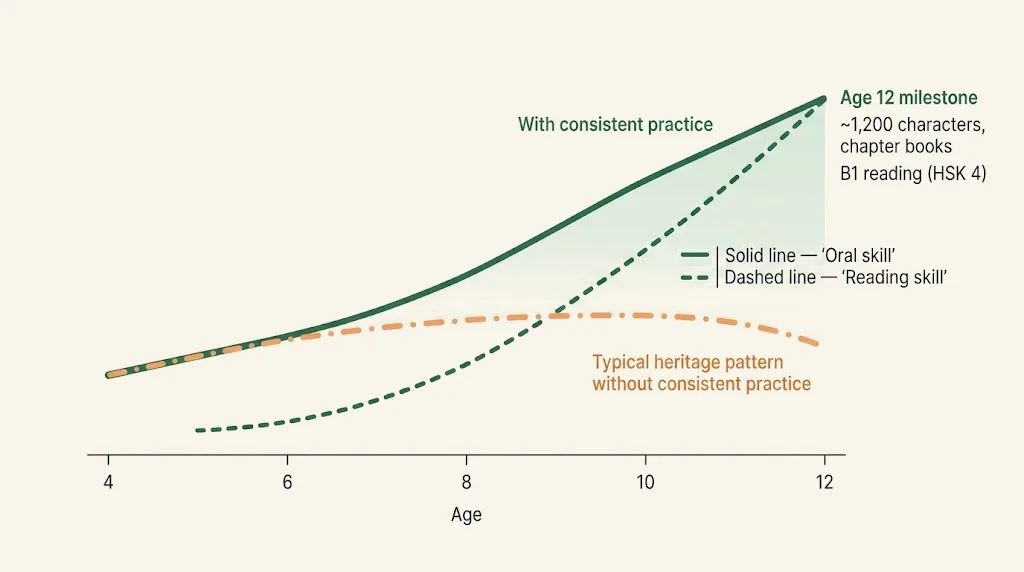
The descriptive research on North American weekend-school kids — Xiao (2006), Wong and Xiao (2010), Chao’s earlier descriptive work (1997), Lu and Li (2008) — finds character recognition in the low-to-mid hundreds. Commonly 300 to 600 by middle school. That isn’t a failure picture. Those kids hold conversations with grandparents, recognize Chinese on storefronts and menus, and read what their Saturday school assigns them. They are not, however, reading in the Stage-3 sense. They are not picking up a novel.
A smaller subset reaches higher. 700 characters, occasionally close to a thousand, in families with serious home investment: an academically-trained parent reading aloud nightly, a weekly tutor, summer immersion in Taipei or Taichung with cousins. These are the historical paths to the upper band, and they require resources most heritage families don’t have. My family doesn’t have them either. I can read Chinese above my daughter’s level but I am not an academically-trained reading instructor, and there is no $60-an-hour tutor coming to our house on a Tuesday.
The gap between the typical 300-to-600 outcome and the 1,200-character goal is what regular short practice is designed to close. It’s the active ingredient of “strong home investment,” delivered without an academic parent or a tutor. Across the descriptive literature, ten to fifteen minutes of reading practice between weekend-school sessions is what most separates the kids who reach the upper band from the kids who stall in the low hundreds.
One thing to be honest about. There is not yet longitudinal data on app-assisted heritage Mandarin learners — that intervention is too new, the field is small. The mechanism (Montrul’s Literacy Enhancement Hypothesis plus the broader heritage maintenance literature converging on reading-in-addition-to-speaking) is well-established. The delivery is what we’re betting on. We’ll know whether app-delivered practice closes the gap the way the literature predicts when the longitudinal data exists. Until it does, what gets published here is what the research describes, not what an app promises.
What the upper band looks like at age 12, for a family aiming at it:
- Character recognition trending toward ~1,200. Compound growth across the full window. Passing 600 by ages 10 or 11 is on-track pacing, not behind.
- Reading. Graded readers giving way to early chapter books. Short Chinese text without sentence-by-sentence translation.
- Oral. Sustained conversation with family on familiar topics, with age-appropriate vocabulary for school, daily life, and feelings.
- Writing. Recognition runs ahead of production, which is developmentally normal. A few hundred actively-produced characters is typical at this age and fine.
These describe outcomes for a family actively working toward the goal. They are not guarantees. They describe what the research supports for kids whose oral skills are paired with a growing reading habit through the window.
What the research says actually helps
Five principles show up across the literature. They are not surprising. They are the things families who reach the upper band tend to do, and they are mostly about tone rather than tactics.
Cultural capital, not obligation. The kids who emerge from Tse’s ambivalence stage and re-engage with their heritage language are usually the ones who built positive associations with it earlier. “Grandma will be sad if you don’t speak Chinese” produces guilt, and guilt is not a durable motivator at age 10. “You can do something most of your classmates can’t” works better, and it has the additional virtue of being true. The pitch to a ten-year-old is the same pitch you’d make to an adult: this is a skill, you’re already most of the way there, finishing it costs less than starting it.
Tuesday should not feel like Saturday. Most heritage families I know lean on a weekend school and consider it essential. The problem isn’t weekend school. The problem is when the at-home routine replicates the parts of weekend school that drive resistance at age 10 — the testing, the long blocks, the homework framing — and then asks for that plus the actual weekend school. Kondo-Brown’s 2006 volume is blunt about this: family language policy is necessary, but the texture of the practice matters as much as the quantity. The Tuesday version needs to feel like a different thing. Shorter, lower-stakes, lower-stuck, and built around things the kid finds interesting rather than things the kid’s parents find culturally important.
Let the kid own the bilingual identity. No guilt mechanics. No “you should be better at this by now.” Code-switching is a skill. The practice tool, the weekend school, the calls with grandparents all work better when they feel like things that belong to the child, rather than things being done to the child on behalf of a family aspiration. The Self-Determination Theory literature on autonomy support has been making this point about kids and motivation for forty years; it applies to language practice the same way it applies to soccer.
Integrate, don’t compete. A ten-year-old has homework, sports, friends, and screen time she is protective of. Practice that displaces something she wants to do creates resentment that ends up costing more than the practice gains. Practice that fits into the margins — ten minutes before dinner, fifteen minutes in the car on the way to swim practice — has a much better chance of becoming a habit than a battle. My daughter does most of her practice between getting in the car and arriving at the next place she’s going.
From parent-driven to parent-supported. At five, the parent picks when and how. At ten, the kid needs meaningful ownership over the small decisions — when, how long, which topics. The parent’s role shifts from daily supervisor to weekly observer. The autonomy-support literature treats this transition as not really optional; the only question is whether it happens by design or by conflict. I am, very actively, trying to do it by design. I do not always succeed.
What this means for your family
Three rough scenarios cover most of the heritage families I talk to.
If your kid is under 8. This is the build-up window. Treat it as such, and don’t panic about character counts yet. Oral skills are the priority — keep doing the things that work at home with family language, stories, songs — and early character exposure through shared reading and short regular practice lays the groundwork for the literacy ramp that becomes consequential after age 8. A kid arriving at 8 with a hundred familiar characters and a positive relationship to Chinese books is in strong shape to compound toward the upper band by 12. At this age, the habit of looking at Chinese text and finding something recognizable in it matters more than the count. What heritage learners actually need walks through the skill profile. The zhuyin-and-pinyin question is one of the earliest concrete choices you’ll make.
If your kid is 8 to 12 and hasn’t started reading Chinese yet. It isn’t too late, and the upper band is still reachable for many families that start now. The window is open through 12, and the kids who gain the most ground in it are often the ones whose families began late and committed to regular practice once they began. The approach matters more than the hours. Forced drilling at this age backfires; short, choice-driven practice with content the kid finds interesting has a better track record than doubling down on workbooks. If your weekend school is already on the calendar, our guide to organizing the week around it is the most concrete starting point for what to do Monday through Friday.
If your kid is 13 or older. This article is mostly about the 8-to-12 window because that’s where the literature concentrates. By 13, your kid is past the easiest compounding years — not past Mandarin. Tse’s research describes a reconnection stage in the late teens and twenties, often triggered by travel, a heritage-program class in college, a partner, or just the moment your kid notices their bilingualism is an asset and not a chore. The teens who reconnect most easily are the ones who held some reading ability through the earlier years. They have something to come back to. The teens who didn’t aren’t out of the running; they’re starting a harder version of the same project. DeKeyser’s research on age and language learning is relevant here — the upside is that explicit instruction (grammar explanations, character components as patterns, comparative analysis across languages) starts pulling more weight than raw immersion. A motivated thirteen-year-old can do more with a focused thirty-minute session than a six-year-old can with an hour of being read to. The shape of the practice changes; the principle — short, regular, retrieval-shaped sessions in the margins of a real life — doesn’t. If your teen is interested, that interest is the active ingredient; if they aren’t yet, the move is to leave the door open and not make Mandarin the thing they have to push back against.
No single thing is enough. Home language use, community ties, trips to family, books and shows in Mandarin, and regular practice all play a part. Families who reach the upper band of the age-12 range aren’t doing one thing right. They’re doing several things consistently. Regular short reading practice between weekend-school sessions is the piece most commonly missing in the typical-today picture, and it is the piece the literature most consistently identifies as the one that moves the number.
What it actually looks like
The thing nobody tells you when you start is that the 8-to-12 window is not a deadline. It’s a window. It’s open right now, it will be open next Tuesday, and the families who get to the upper end of the age-12 range are not doing one heroic thing. They’re doing one small thing on most days.
I have read the literature carefully enough to be honest about what it does and doesn’t say. It says oral-only heritage Mandarin is fragile past childhood and a regular reading habit is what most separates the kids who keep building from the kids who plateau. It does not say which app, which tutor, or which weekend school will close the gap for your specific kid. There isn’t longitudinal data on app-assisted heritage learners yet because the intervention is too new. The mechanism is well-established. The delivery is what we’re all figuring out.
What I can tell you is this: the kids who reach early chapter books at 12 are almost never the kids whose parents waited for the right tool. They’re the kids whose parents put ten minutes on Tuesday.
About the author
James Wann is the founder of MandarinBytes and father of an 8-year-old daughter at a Taiwanese-heritage Saturday school in Seattle. Before MandarinBytes, he led personalization data at Disney across Disney+, Hulu, and ESPN, and spent three decades building software that adapts to individual users at consumer scale.
Research cited in this article
- Chall, J. S. (1983). Stages of Reading Development. McGraw-Hill.
- Chao, T. H. (1997). Chinese heritage community language schools in the United States. ERIC Digest.
- DeKeyser, R. M. (2000). The robustness of critical period effects in second language acquisition. Studies in Second Language Acquisition, 22(4), 499–533.
- Kondo-Brown, K. (Ed.). (2006). Heritage Language Development: Focus on East Asian Immigrants. John Benjamins.
- Lu, X., & Li, G. (2008). Motivation and achievement in Chinese language learning. In T. G. Wiley et al. (Eds.), Handbook of Heritage, Community, and Native American Languages in the United States. Routledge.
- Montrul, S. (2016). The Acquisition of Heritage Languages. Cambridge University Press.
- Polinsky, M., & Kagan, O. (2007). Heritage languages: In the “wild” and in the classroom. Language and Linguistics Compass, 1(5), 368–395.
- Shu, H., Chen, X., Anderson, R. C., Wu, N., & Xuan, Y. (2003). Properties of school Chinese: Implications for learning to read. Child Development, 74(1), 27–47.
- Tse, L. (2000). The effects of ethnic identity formation on bilingual maintenance and development: An analysis of Asian American narratives. International Journal of Bilingual Education and Bilingualism, 3(3), 185–200.
- Wong, K. F., & Xiao, Y. (2010). Diversity and difference: Identity issues of Chinese heritage language learners from dialect backgrounds. Heritage Language Journal, 7(2), 153–187.
- Xiao, Y. (2006). Heritage learners in the Chinese language classroom: Home background. Heritage Language Journal, 4(1), 47–56.